Premium Course

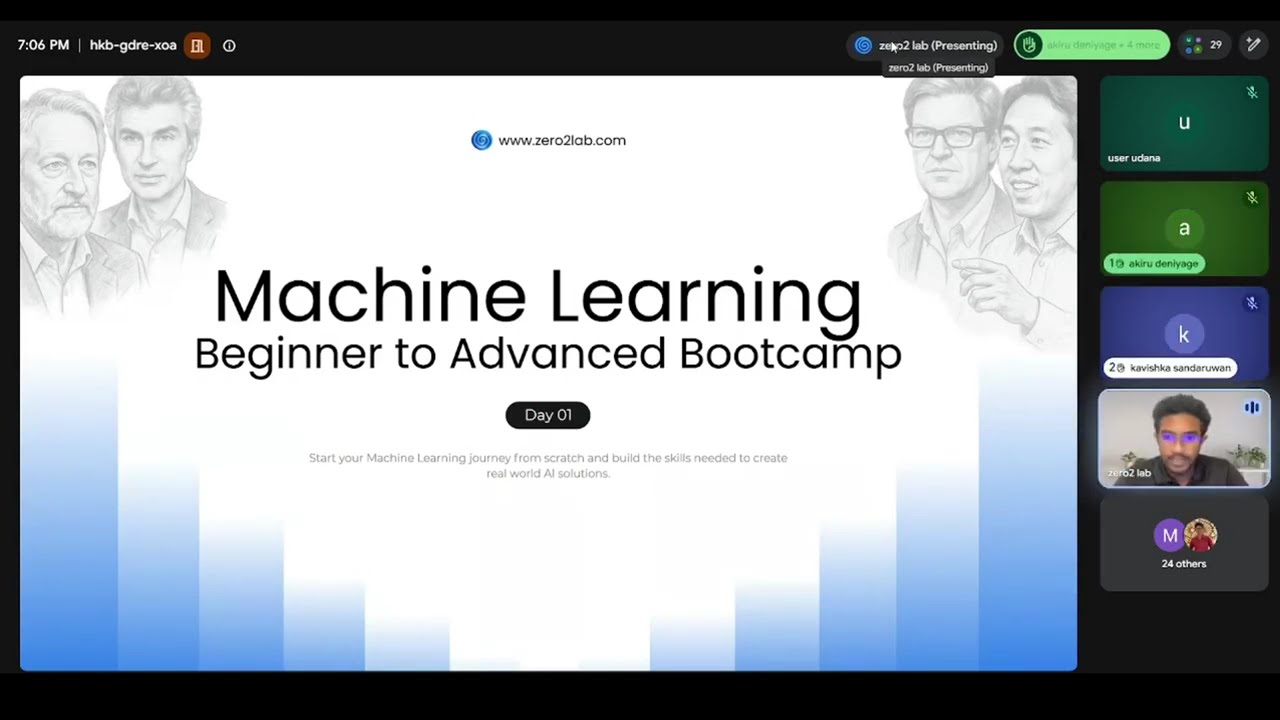
Machine Learning BootcampBeginner to Advanced

Welcome to the ultimate Machine Learning journey. Whether you are a complete beginner starting your programming journey, a developer who wants to improve your skills, or an aspiring data scientist preparing for an industry career, this bootcamp is designed to guide you step by step from your current level.

0
(0 reviews)
30+ students enrolled
Last updated 07/2026
Sinhala

What you'll learn

6 Core Outcomes
Master the Fundamentals: Gain a rock-solid foundation in Python programming, NumPy, Pandas, and the essential Mathematics & Statistics required for Data Science.
Build Predictive Models: Implement Supervised and Unsupervised Learning algorithms including Regression, Classification, SVM, Decision Trees, and Clustering.
Leverage Ensemble Techniques: Achieve high accuracy using advanced algorithms like Random Forest, AdaBoost, Gradient Boosting, and XGBoost.
End to End Project Lifecycle: Master the 10 stages of an AI project lifecycle, from Data Collection and Feature Engineering to Model Tuning and Evaluation.
Real World Application: Complete enterprise level projects including Healthcare Prediction and Credit Risk Modelling.
Industry Standard MLOps & Cloud: Deploy your models securely using Streamlit and FastAPI. Master experiment tracking with MLflow and learn model training on AWS SageMaker.

Requirements

  • •A solid understanding of Python is required.
  • •Prior AI/ML experience is helpful but not necessary. This course is ideal for developers, AI enthusiasts, and tech professionals specializing in automation.
  • •Hardware: A modern computer (Windows, macOS, or Linux) with at least 4GB of RAM

Description

Welcome to the ultimate Machine Learning journey. Whether you are a complete beginner starting your programming journey, a developer who wants to improve your skills, or an aspiring data scientist preparing for an industry career, this bootcamp is designed to guide you step by step from your current level.

This course connects theory with real world practice. Instead of only learning basic definitions from textbooks, you will experience the actual workflow of an AI/ML Engineer. You will learn the mathematics and algorithms behind Machine Learning, and you will also build, deploy, and monitor real machine learning models using industry tools like AWS, MLflow, and FastAPI.

By the end of this bootcamp, you will have the practical skills and hands on experience needed to turn your knowledge into real world expertise that employers value.

Course Content

15 sections  •  174 lectures  •  2 month 14 h self practice total

Start Learning for Free!

The 3 days are completely unlocked. Watch them now without any payment.

1.1 What is Machine Learning?
Preview
1.2 Classification vs Regression
Preview
1.3 Supervised vs Unsupervised Learning
Locked
2.1 Setup Environment
Locked
2.2 Variables
Locked
2.3 Numbers
Locked
2.4 Strings
Locked
2.5 Lists
Locked
2.6 If Condition
Locked
2.7 For Loop
Locked
2.8 Functions
Locked
2.9 Dictionary and Tuples
Locked
2.10 Modules and Pip
Locked
2.11 File Handling
Locked
2.12 Classes and Objects
Locked
2.13 Inheritance
Locked
2.14 Exception Handling
Locked
3.1 Introduction and Benefits
Locked
3.2 Basic Operations
Locked
3.3 Matrix Operations
Locked
3.4 Slicing, Stacking
Locked
4.1 Pandas Introduction and Installation
Locked
4.2 Dataframe Basics
Locked
4.3 Read, Write Excel and CSV Files
Locked
4.4 Handle Missing Data
Locked
4.5 Grouping Data
Locked
4.6 Data Concatenation and Merging
Locked
4.7 Data Visualization Using Matplotlib and Seaborn
Locked
5.1 Descriptive vs. Inferential Statistics
Locked
5.2 Measures of Central Tendency: Mean, Median, Mode
Locked
5.3 Percentile
Locked
5.4 Analysis: Shoe Sales (Using Mean, Median, Percentile)
Locked
5.5 Measures of Dispersion: Range, IQR
Locked
5.6 Box or Whisker Plot
Locked
5.7 Outlier Treatment Using IQR and Box Plot
Locked
5.8 Measures of Dispersion: Variance and Standard Deviation
Locked
5.9 Analysis: Stock Returns Volatility (Using Variance and Std Dev)
Locked
5.10 Correlation
Locked
5.11 Correlation vs Causation
Locked
5.12 Probability Basics
Locked
5.13 Addition and Multiplication Rule
Locked
5.14 Conditional Probability and Bayes Theorem
Locked
5.15 What Is a Distribution?
Locked
5.16 Skewness
Locked
5.17 Normal Distribution
Locked
5.18 Detect Outliers Using Normal Distribution
Locked
5.19 Z Score
Locked
5.20 Standard Normal Distribution (SND)
Locked
5.21 Random Sampling & Sample Bias
Locked
5.22 The Law of Large Numbers
Locked
5.23 Central Limit Theorem, Sampling Distribution
Locked
5.24 Case Study: Solar Panels
Locked
5.25 Standard Error
Locked
5.26 Z Score Table (Z-Table)
Locked
5.27 Confidence Interval
Locked
6.1 Simple Linear Regression
Locked
6.2 Multiple Linear Regression
Locked
6.3 Cost Function
Locked
6.4 Derivatives and Partial Derivatives
Locked
6.5 Chain Rule
Locked
6.6 Gradient Descent Theory
Locked
6.7 Gradient Descent: Python Implementation
Locked
6.8 Why MSE (and not MAE)?
Locked
6.9 Model Evaluation: Train, Test Split
Locked
6.10 Model Evaluation: Metrics
Locked
6.11 Data Preprocessing: One Hot Encoding
Locked
6.12 Polynomial Regression
Locked
6.13 Overfitting and Underfitting
Locked
6.14 Reasons and Remedies For Overfitting / Underfitting
Locked
6.15 L1 and L2 Regularization
Locked
6.16 Bias Variance Trade Off
Locked
7.1 Introduction to Classification
Locked
7.2 Logistic Regression: Binary Classification
Locked
7.3 Model Evaluation: Accuracy, Precision and Recall
Locked
7.4 Model Evaluation: F1 Score, Confusion Matrix
Locked
7.5 Logistic Regression: Multiclass Classification
Locked
7.6 Cost Function: Log Loss
Locked
7.7 Support Vector Machine (SVM)
Locked
7.8 Data Pre-processing: Scaling
Locked
7.9 Sklearn Pipeline
Locked
7.10 Naive Bayes: Theory
Locked
7.11 Naive Bayes: SMS Spam Classification
Locked
7.12 Decision Tree: Theory
Locked
7.13 Decision Tree: Salary Classification
Locked
7.14 Handle Class Imbalance: Theory
Locked
7.15 Handle Class Imbalance Using imblearn: Churn Prediction
Locked
8.1 What is Ensemble Learning?
Locked
8.2 Majority Voting, Average and Weighted Average
Locked
8.3 Bagging
Locked
8.4 Bagging: Random Forest
Locked
8.5 Random Forest: Raisin Classification
Locked
8.6 Boosting: AdaBoost
Locked
8.7 Gradient Boosting: Regression Walk Through
Locked
8.8 Gradient Boosting: Regression Math
Locked
8.9 Gradient Boosting: Revenue Prediction
Locked
8.10 Gradient Boosting: Classification
Locked
8.11 XGBoost: Walk Through
Locked
8.12 XGBoost: California Housing Prediction
Locked
8.13 XGBoost: Synthetic Data Classification
Locked
8.14 XGBoost: Benefits
Locked
9.1 Introduction
Locked
9.2 Model Evaluation: ROC Curve & AUC
Locked
9.3 Cost Benefit Analysis Using ROC in Sklearn
Locked
9.4 K Fold Cross Validation
Locked
9.5 Stratified K Fold Cross Validation
Locked
9.6 Hyperparameter Tuning: GridsearchCV
Locked
9.7 Hyperparameter Tuning: RandomizedSearchCV
Locked
9.8 Model Selection Guide
Locked
9.9 Selecting the Right Evaluation Metric
Locked
10.1 Stages of AI Project Life Cycle
Locked
10.2 Requirements and Scope of Work (SOW)
Locked
10.3 Data Collection
Locked
10.4 Data Cleaning & Exploratory Data Analysis
Locked
10.5 Feature Engineering
Locked
10.6 Model Selection & Training
Locked
10.7 Model Fine Tuning
Locked
10.8 Model Deployment
Locked
10.9 Monitoring and Feedback Using ML Ops
Locked
11.1 three Ways of Doing Feature Engineering
Locked
11.2 Feature Selection Using Correlation
Locked
11.3 Feature Selection Using Variance Inflation Factor (VIF)
Locked
11.4 VIF: Practical Implementation (Salary Prediction)
Locked
12.1 Introduction
Locked
12.2 K Means Clustering: Theory
Locked
12.3 K Means Clustering: Customer Segmentation
Locked
12.4 Hierarchical Clustering: Theory
Locked
12.5 Hierarchical Clustering: Customer Segmentation
Locked
12.6 DBSCAN: Theory
Locked
12.7 DBSCAN: Practical Implementation
Locked
13.1 Project Charter Meeting
Locked
13.2 Scope of Work, Task Planning in JIRA
Locked
13.3 Data Collection
Locked
13.4 Data Cleaning & EDA
Locked
13.5 Feature Engineering
Locked
13.6 Model Training, Fine Tunning
Locked
13.7 98% Model Accuracy, Really?
Locked
13.8 Error Analysis
Locked
13.9 Model Segmentation
Locked
13.10 Request More Data
Locked
13.11 Model Retraining
Locked
13.12 Deployment
Locked
14.1 Domain Understanding
Locked
14.2 Scope of Work & Tech Architecture
Locked
14.3 Data Collection
Locked
14.4 Quick Intro to Data Leakage
Locked
14.5 Data Cleaning
Locked
14.6 Exploratory Data Analysis (EDA)
Locked
14.7 Feature Engineering
Locked
14.8 Weight of Evidence (WOE), Information Value (IV)
Locked
14.9 Model Training & Evaluation
Locked
14.10 Introduction to Optuna
Locked
14.11 Model Fine Tuning Using Optuna
Locked
14.12 Intro To Rank Ordering & KS Statistic
Locked
14.13 Model Evaluation Using KS Statistic & Gini Coefficient
Locked
14.14 Business Presentation
Locked
14.15 Deployment
Locked
15.1 What is ML Ops?
Locked
15.2 Importance of ML Ops in Your Career
Locked
15.3 ML Flow: Purpose and Overview
Locked
15.4 ML Flow: Experiment Tracking
Locked
15.5 ML Flow: Model Registry
Locked
15.6 ML Flow: Centralized Server Using Dagshub
Locked
15.7 What is API?
Locked
15.8 FastAPI Basics
Locked
15.9 Build FastAPI Server Project
Locked
15.10 Git Version Control System
Locked
15.11 Introduction to ML Cloud Platforms
Locked
15.12 AWS Sagemaker: Account Setup
Locked
15.13 AWS Sagemaker: Sagemaker Studio
Locked
15.14 AWS Sagemaker: 4 Ways to Train Model
Locked
15.15 AWS Sagemaker: Built In Algorithms
Locked
15.16 AWS Sagemaker: Script Mode
Locked
15.17 Data Drift Detection Using PSI & CSI
Locked
15.18 PSI & CSI: Practical Implementation
Locked

Frequently Asked Questions

Course Preview
Watch Introduction Session
Rs. 10,000Rs. 12,000Save Rs. 2,000 when you pay in full
Loading...

30-Day Money-Back Guarantee

Includes

60h video
5+ projects
Lifetime
Certificate